‘Made in China’ Luxury Goods Demand Transparency from Brands
April 30, 2025
Over the past few weeks, popular Western luxury brands have been at the center of controversy as they face a series of viral Chinese TikTok videos exposing that most of their sought-after products are actually ‘Made in China’ luxury items. The allegations gained worldwide attention amid US President Donald Trump’s ongoing 145% tariffs on Chinese imports.
These self-described Chinese “manufacturers” showcasing what appear to be luxury goods and factory workers in the background are promoting a narrative that Made in China luxury brands are marked up significantly by traditional retailers. They encourage viewers to bypass these “middlemen” and purchase directly from them.
Some people believe these videos are genuine and reveal industry truths. Others remain skeptical, viewing these self-proclaimed manufacturers as potentially misleading about their connections to authentic luxury brands. They suspect these presenters may be using global trade conflicts as a backdrop to sell lower-quality goods directly to consumers searching for deals during uncertain economic times.
Could Factory Insiders on TikTok Be Revealing the True Cost of Luxury?
TikTok videos showcasing factory machinery and workers reveal rows of items resembling luxury designs. These videos claim Western luxury goods are largely made in China despite ‘European made’ labels, and that ‘Made in China’ luxury brands cost a tiny fraction of retail prices, suggesting enormous markups by established brands.
Sen Bags_Store, a Chinese TikTok user, shows his audience what appears to be a Hermès Birkin bag. He then proceeds to share information claiming that while a retail Birkin costs nearly $38,000, the luxury manufacturing process of ‘Made in China’ luxury bags actually involves much lower material costs, suggesting the high price is primarily markup rather than production value.
Chinese influencer LunaSourcingChina challenges a common misconception in her viral TikTok video, claiming it’s false that “the Chinese government pays tariffs” on ‘Made in China’ luxury goods. She states that tariffs create a cascading cost effect through the supply chain—factories refuse losses, importers pass costs downstream, and consumers ultimately pay higher prices at checkout.
While her tariff explanation correctly notes that importing country consumers primarily bear tariff costs (aligning with economic consensus), these videos often promote direct Chinese manufacturer purchases as a way to circumvent tariff-inflated retail prices. Her strategy likely leverages the de minimis rule, which allows goods valued below certain thresholds to enter duty-free, raising questions about her actual intentions beyond economic education.
These Chinese TikTok videos fail to explain costs beyond basic production in luxury goods. They highlight tangible production expenses like materials and labor but it only represents a fraction of luxury retail prices.
The substantial markup stems from brand reputation and heritage, design and R&D expenses, marketing, upscale retail operations, exclusivity strategies, quality assurance, sustainability initiatives, and customer service. In short, their claim to simplified cost comparison misleads viewers by ignoring these essential business elements that contribute to the final price.
Brand Responses and Narrative Control
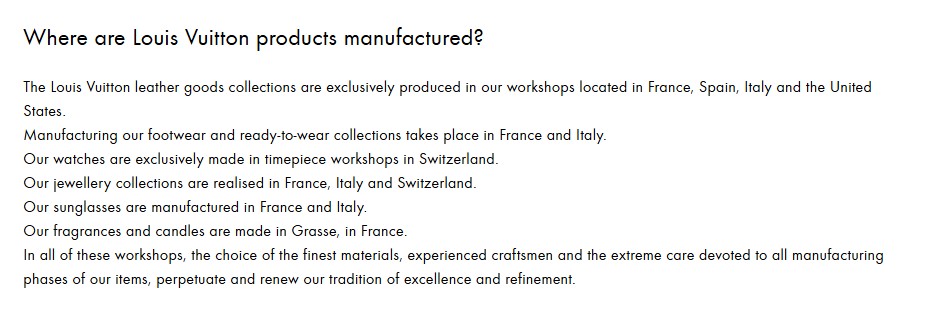
Luxury brands like Louis Vuitton have consistently upheld transparency regarding its manufacturing processes long before the “Made in China” exposés gained popularity. The luxury brand has a well-established tradition of openly communicating about its production methods, craftsmanship standards, and manufacturing locations across its global workshops.
Screenshot from Louis Vuitton
Some luxury brands have indeed remained silent when faced with allegations about their production practices and geographic sourcing. Brands may calculate that acknowledging production in Asia could potentially damage their carefully cultivated European heritage narrative. Many brands prefer to let the controversy pass rather than risk compromising their luxury image.
Eroding Trust and the Quest for Authenticity
The way people view luxury goods is shifting due to viral videos, tariffs, and brand responses, leading many to question if high prices are justified and to suspect they’re primarily paying for advertising rather than superior quality.
As for the consumers, there’s an ongoing discussion not only on TikTok but on different online platforms where it focuses on how we view “luxury” means today. Luxury brands now face a critical challenge to reconsider their value proposition as consumers increasingly feel excluded from traditional luxury markets. This widespread phenomenon ignites provocative questions about whether authentic luxury still exists in our era of increasing economic inequality, and whether such exclusivity should remain reserved only for the privileged few.
The Future of Luxury in an Age of Transparency
It’s an open secret that many counterfeit luxury goods originate from China. People tend to buy these brands, even if they are fake, because of the story or idea that these luxury brands carry, and having them would reflect who they are as individuals.
It is also important to note that aside from the cost of these luxury items, another significant factor is the power of TikTok operating on a global scale and how it now influences the world of luxury goods.
It is no coincidence that these TikTok videos are widely viewed, as the platform’s algorithm has been deliberately designed to maximize global exposure of such content. In this case, the platform appears to be leveraging its technology to influence public perception amid the ongoing US-China tariff dispute.
The power of TikTok’s algorithms is changing how we think about luxury products. China TikTok luxury brands flood the app with seemingly high-end items at fraction of authentic prices attracting buyers seeking luxury status despite knowing products may be counterfeit.
Videos from Chinese TikTok luxury brands stick in viewers’ minds even after being deleted, making them question why “real” luxury costs so much. Behind all this is the complicated relationship between luxury manufacturing, social media influence, and the trade fight between America and China. When you scroll through TikTok, you’re actually seeing a battle over who controls what we think is valuable and worth our money.
Jasper is a copywriter focused on beauty, culture, sports, and digital marketing. He draws inspiration from running and reading literary novels to create work that connects with people.